
Teenage anxiety often shows up as a pattern of excessive worry, irritability, physical complaints (like headaches or stomachaches), avoidance of school or social situations, and changes in sleep, grades, or mood that last for weeks – not just a stressful day or two.
Anxiety can be quiet and easy to miss in teens, especially when it looks like “attitude,” perfectionism, or constant exhaustion.
Adolescence is full of normal pressure: friendships, school performance, identity, sports, and the push to become more independent. But when anxiety starts to run the day – shrinking your teen’s world or making it hard to function at home, school, or with friends – it’s time to pay attention and take supportive steps.
Anxiety is more than typical nervousness before a test or a big game. It’s a persistent state of fear, worry, or dread that can feel overwhelming and hard to control. Many teens with anxiety want to feel calm and confident but don’t know how to turn their brain and body “off.”
In teenagers, anxiety commonly shows up in ways that confuse parents and caregivers because it can look like:
Irritability instead of fear
Withdrawal instead of sadness
Procrastination instead of “not caring”
Physical symptoms instead of emotional ones
Anxiety also tends to be self-protective. If your teen’s brain believes something is dangerous (even when it isn’t), it pushes them to avoid it. Avoidance can bring short-term relief – so the brain learns to do it more – until their life starts to narrow.
If you want a broader overview of this condition, you can also read more on anxiety.
Anxiety symptoms usually fall into three categories: psychological (thoughts/feelings), physical (body sensations), and behavioral (actions). Many teens experience some symptoms in all three areas.
Below are common signs your teenager has anxiety, with examples to help you connect what you’re seeing to what your teen might be experiencing internally.
These are the internal experiences – worries, fears, and thought patterns – that often drive anxious behavior.
Excessive worry that feels hard to stop
Worrying about grades, friendships, world events, safety, or “messing up”
Asking “What if…?” questions constantly
Spiraling into worst-case scenarios
Racing thoughts or mental “noise”
Describing their mind as “never quiet”
Getting stuck replaying conversations or mistakes
Overthinking texts, tone, facial expressions, or social interactions
Perfectionism and fear of failure
Panic at the idea of getting anything less than an “A”
Feeling like mistakes are “disasters”
Refusing to start something unless they can do it perfectly
Irritability and low frustration tolerance
Snapping quickly or seeming “on edge”
Reacting intensely to small problems
Becoming argumentative when pressured
Excessive guilt or self-criticism
Harsh self-talk (“I’m stupid,” “I ruin everything”)
Taking responsibility for things outside their control
Feeling like they are a burden
Difficulty concentrating
Trouble focusing while reading or studying
Staring at homework but not absorbing information
Forgetfulness that seems new or worse than before
Reassurance-seeking
Repeatedly asking for confirmation: “Are you mad at me?” “Is this okay?” “Are you sure?”
Not feeling relief for long – even after reassurance
These psychological symptoms matter because they can quietly become your teen’s “normal,” even when they’re suffering. If you’re noticing ongoing patterns, that can be a meaningful clue.
Teens don’t always have words for anxiety – so their body speaks for them. Physical symptoms are a major part of the signs your teenager has anxiety, especially when medical causes have been ruled out.
Stomachaches, nausea, or digestive issues
Complaints that increase on school mornings or before events
Needing frequent bathroom breaks when stressed
Headaches or muscle tension
Tight shoulders/jaw clenching
Frequent headaches without a clear cause
Racing heart, shortness of breath, or shakiness
Feeling “amped,” jittery, or dizzy
Episodes that look like panic (sudden fear + strong body symptoms)
Sleep problems
Trouble falling asleep due to worry
Waking in the night or very early
Sleeping too much due to exhaustion
Fatigue
Feeling drained even with adequate sleep
Low energy that worsens during stressful weeks
Changes in appetite
Eating much less due to nausea or stress
Eating more for comfort or to self-soothe
Because teens are growing, busy, and often sleep-deprived, physical anxiety symptoms can be dismissed. The key is the pattern: symptoms that show up around stress, avoidance, or emotional pressure.
Behavior is often where anxiety becomes most visible to families – because anxiety changes what teens do, not just what they feel.
Avoidance
Refusing school, activities, sports, performances, or driving practice
Skipping events they used to like
Avoiding specific classes, teachers, or social groups
Avoidance is one of the strongest outward signs your teenager has anxiety – and it can grow quickly if the teen learns avoidance is the only way to feel safe.
Procrastination or shutdown
Putting off homework or projects until panic hits
Saying “I don’t care” when they actually care a lot
Freezing at the start of tasks (especially big ones)
Increased conflict at home
Meltdowns around routines: getting to school, leaving the house, bedtime
Defensiveness when asked simple questions
Anger that seems “out of proportion”
Social withdrawal
Spending most of their time alone in their room
Declining invitations, not responding to friends
Seeming “done” with people after small social stressors
Frequent checking behaviors
Re-reading messages repeatedly
Checking grades obsessively
Needing to confirm plans again and again
Changes in performance
Grades dropping due to concentration issues or avoidance
Overworking to the point of exhaustion (burnout)
Quitting activities because they feel too stressful
Increased reliance on “safety behaviors”
Always needing a parent nearby
Needing to sit near exits
Avoiding eating in public or speaking in class
A quick note: not every change in behavior is anxiety. Teens may withdraw due to depression, stress, grief, trauma, substance use, or other concerns. But sustained avoidance plus worry/irritability plus physical symptoms is a common anxiety cluster.
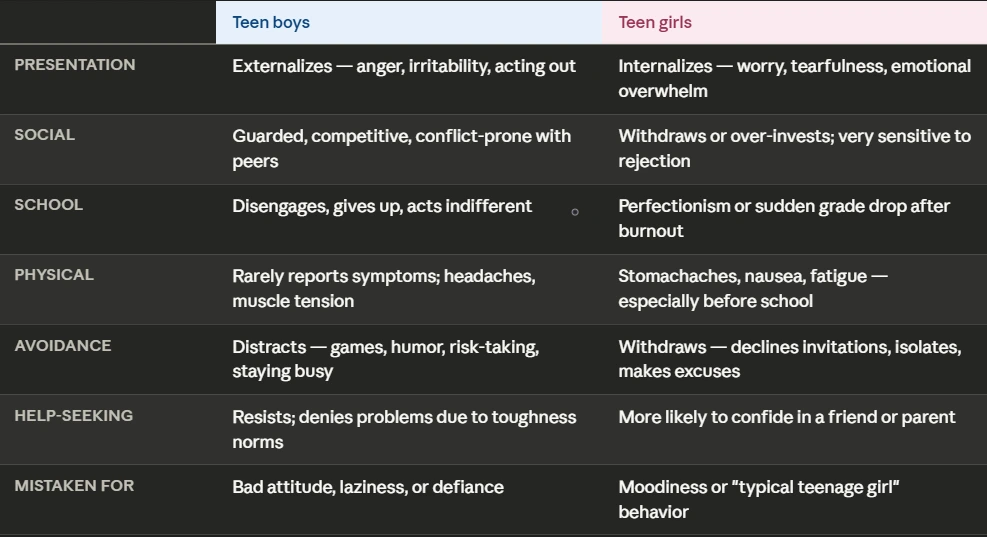
Anxiety doesn’t look the same for every teen, and it’s also shaped by gender, personality, and social expectations.
You don’t have to wait for a full crisis to seek support. Consider reaching out for professional help when:
Symptoms last more than a few weeks and don’t improve with routine changes
Anxiety interferes with school attendance, grades, and completing basic responsibilities
Your teen stops doing things they used to enjoy
There are frequent physical complaints tied to stress (stomachaches, headaches, panic-like symptoms)
Your family is “walking on eggshells” because stress reactions are escalating
Your teen is using avoidance as their main coping strategy
You notice persistent hopelessness, intense distress, or emotional shutdown
If anxiety is tied to difficult life experiences or trauma, more specialized support may be helpful.
Archway offers trauma-focused resources, including information on trauma and treatment options like EMDR.
If you’re uncertain what’s “normal teen stress” versus something bigger, it can still be worthwhile to consult a therapist, especially when the signs are affecting daily functioning.
When parents and caregivers learn anxiety-supportive strategies, it often reduces power struggles and helps teens feel less alone. The goal is not to eliminate all anxiety (that’s impossible), but to help your teen build skills and confidence to handle it.
Here are practical, evidence-informed ways to support your teen at home:
Instead of “You’re being dramatic,” try:
“I’m noticing mornings feel really hard lately.”
“It seems like your stomach hurts more on school days.”
“It looks like this is bringing up a lot of stress.”
This approach keeps the door open. Many teens fear being judged, punished, or forced – so gentle observations can feel safer than direct accusations.
Validation is not agreeing with anxious predictions – it’s acknowledging the feeling.
“That sounds really overwhelming.”
“I can see why you’d want to avoid that.”
Then add calm structure:
“And we’re still going to take the next small step together.”
Teens do better when they feel emotionally safe and guided.
Reassurance is comforting, but if it becomes constant, it can accidentally reinforce anxiety. If your teen repeatedly asks the same question (“Are you sure I won’t fail?”), consider:
Answering once clearly, then
Shifting to coping: “What’s your plan if you feel anxious during the test?”
Encouraging self-trust: “What helped last time?”
This helps your teen strengthen internal coping instead of needing certainty before acting.
Avoidance makes anxiety stronger over time. Exposure – done gradually and supportively – helps anxiety shrink.
You can help by breaking tasks into manageable steps, such as:
Step 1: Email the teacher
Step 2: Attend first period
Step 3: Stay until lunch
Step 4: Complete one missing assignment
Celebrate effort, not just outcome. The win is showing up.
Anxiety loves chaos. Routines help regulate the nervous system.
Consistent sleep/wake times (as much as possible)
A wind-down routine without intense conflict
Regular meals and hydration (low blood sugar can mimic anxiety)
Movement and time outside when feasible
This isn’t about a “perfect lifestyle.” It’s about giving the body a steadier baseline so anxious spikes are less intense.
Some teens open up through side-by-side moments (driving, walking, chores) rather than face-to-face talks. You can try:
“Where do you feel stress in your body?”
“What’s the hardest part of the day lately?”
“If your anxiety had a voice, what would it say?”
If they don’t answer, don’t lecture. Keep offering calm opportunities.
Anxiety often comes with shame: “Why can’t I just do it?”
Remind your teen:
Anxiety is a body-and-brain response, not a character flaw.
Skills can be learned – like emotion regulation, mindfulness, and communication.
Therapy can support skill-building using structured approaches such as CBT, DBT, or ACT.
When teens feel controlled, anxiety and resistance often increase. Aim for teamwork:
“What would make mornings 10% easier?”
“Do you want reminders, or do reminders make it worse?”
“Would you rather talk to someone outside the family about this?”
You can be supportive without becoming the “anxiety police.”
Signs your teenager has anxiety can include ongoing worry, irritability, avoidance, physical complaints, sleep trouble, and changes in school or social behavior, especially when these patterns persist and interfere with daily life. Paying attention early, responding with empathy and structure, and getting professional support when needed can help your teen build confidence and coping skills over time.